A First Visit to a Tennis Match: What to Notice Between Points
A first visit to a tennis match feels richer when you notice court layout, player routines, and the crowd’s shared rhythms between points.
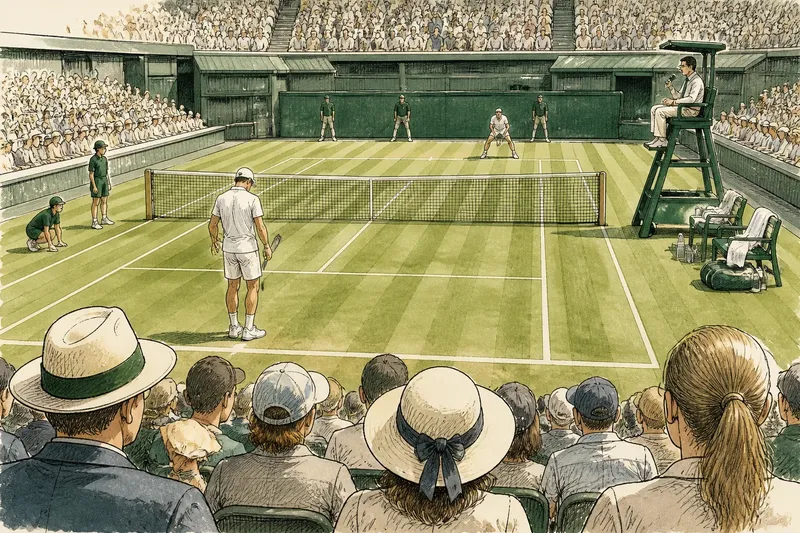
At your first tennis match, the rally may end with a sharp shoe squeak, a ball rolling toward the back fence, and hundreds of people holding still for a beat. A useful way to watch is to follow what happens in that pause: how the court organizes movement, what each player repeats before serving, and how the audience knows when to settle or respond. You can enjoy the match without tracking every score or judging every shot.
Where should you look before play begins?
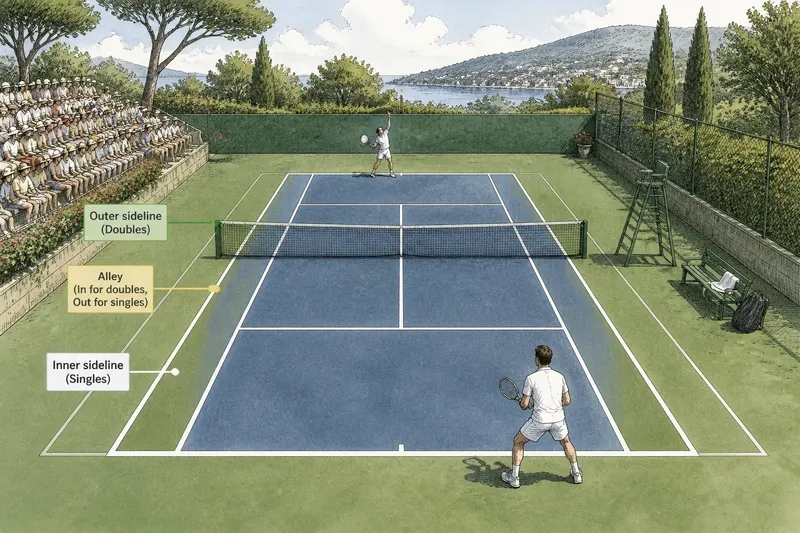
Start with the shape of the playing space. The net divides the court, while the service lines and center mark create smaller zones that come into view as players take position. Rather than trying to memorize every boundary, notice which parts of the court seem to matter in the moment: the service boxes before a serve, the baseline during a rally, or the sideline when a ball lands near the edge.
Find the chair umpire’s seat and the players’ benches, too. Their placement gives you a map of the match’s working space. The umpire looks across the court and makes calls; players return to their benches during breaks, where towels, drinks, and spare equipment are kept. Ball crew members may wait near the corners or net posts, ready to move when play stops. Once you recognize these positions, small transitions become easier to follow.
Choose a comfortable focal point without locking your gaze there. From a high seat, you may see the court’s geometry and the players’ spacing clearly. Closer to court level, the net can hide a low ball, but the players’ footwork and the sound of contact may feel more immediate. Either view offers a different kind of detail; there is no single correct seat from which to understand a match.
What changes when a point ends?
After a point, watch the court reset. The players may walk to retrieve a ball, exchange a glance with the umpire, or head toward their positions. A ball crew member collects loose balls, while the players prepare for the next point. These actions are not empty time. They keep the court clear and establish a brief pause before play resumes.
Notice how attention shifts along with the players. During a rally, spectators often track the ball from side to side. At the end, eyes may move toward the player preparing to serve, the receiving player’s stance, or the umpire. That shared turn of attention is part of the match’s rhythm: the crowd gathers its focus, waits, and then releases it when the point is over.
You do not need to follow the score to tell that the pause has a shape. A player may collect a ball, settle behind the baseline, and take a moment before beginning the next point. The other player may wait at the opposite end, shifting weight or adjusting position. Those choices create a contrast between movement and stillness that is easy to notice even if the scoring terms are unfamiliar.
Which player routines are worth noticing?
Players often repeat small preparations before serving or receiving. One may bounce the ball, check a grip, tug at a shirt cuff, or look toward a target area. A receiver may bend at the knees, make a small adjustment with the feet, and hold the racket in front. These routines can help a player settle attention and prepare the body; they are not secret signals that let a spectator predict the point.
Look for what stays consistent and what changes. A player might use the same sequence before each serve, but take longer after a demanding rally. Another might move closer to the baseline to receive, then ease back on the next point. Treat these details as observations, not explanations: you can see a change in position without claiming to know the player’s thoughts or strategy.
Imagine you are watching a player who pauses at the baseline, turns a ball in one hand, then bounces it before serving. Across the net, the receiver lowers into a ready stance as soon as the server faces forward. You can follow the sequence—pause, preparation, response—without needing to decide whether either player is under pressure or what shot will come next.
How does the audience signal its shared rhythm?
Listen for the audience’s changes in volume. During a point, spectators generally keep quiet so players can hear the ball and move without distraction. Between points, applause may follow a striking rally or a close exchange. If a player is about to serve, the sound often settles again. The pattern makes the quiet feel active: everyone is waiting for play to restart.
Watch for how people respond together. A brief murmur can spread after a ball lands close to a line; a collective exhale may follow a long rally. Applause is not reserved only for the winner of a point. A crowd may acknowledge a difficult effort from either side, then return to silence as the next point begins. The audience is participating through restraint as much as through noise.
At a live match, follow the venue’s posted guidance and the officials’ cues about movement, photography, and quiet. If you arrive late, wait for a suitable pause before taking your seat rather than crossing in front of people during play. These small courtesies help preserve everyone’s view and the players’ concentration.
What questions help you read a match without scorekeeping?
Why does the crowd go quiet before a serve?
Quiet helps keep the players’ attention on the serve and the receiver’s movement. It also marks the transition from the social pause between points to the focused action of the next one.
Why do players bounce the ball before serving?
Bouncing the ball can be part of a player’s familiar preparation and helps establish a steady moment before the serve. The number or pattern is personal, so it is best treated as a routine to observe rather than a code to interpret.
What should I watch if I cannot see the ball clearly?
Follow the players’ feet, their turns toward the ball, and the audience’s reaction. The court’s layout can make the ball difficult to pick out from some seats, but body movement and sound still reveal the rhythm of an exchange.
Is applause appropriate after every point?
People usually applaud for a notable rally or a particularly difficult shot, while ordinary points may pass with little response. If you are unsure, follow the local crowd and leave space for the quiet that comes before the next serve.
How can you leave with a clearer memory of the match?
As you watch, choose one detail from each part of the experience: a court feature that shaped your view, a routine a player repeated, and a moment when the crowd’s mood shifted. You might remember the angle of the service boxes from your seat, the receiver’s bent-knee stance, or the hush that spread before a serve. Those particulars give the day a texture that a score alone may not preserve.
There is little value in trying to identify every tactic or imitate an expert’s commentary while you are still learning how a live match feels. Let the players’ routines and the audience’s pauses hold your attention, and allow the score to remain in the background if that suits you. A first visit to a tennis match becomes easier to follow when you notice how each point ends, how the court resets, and how a crowd prepares to watch again.