Why Tennis Courts Have Lines Outside the Singles Sidelines
Tennis court lines outside the singles sidelines mark the doubles alleys. Learn which boundary applies to each format and read the court at a glance.
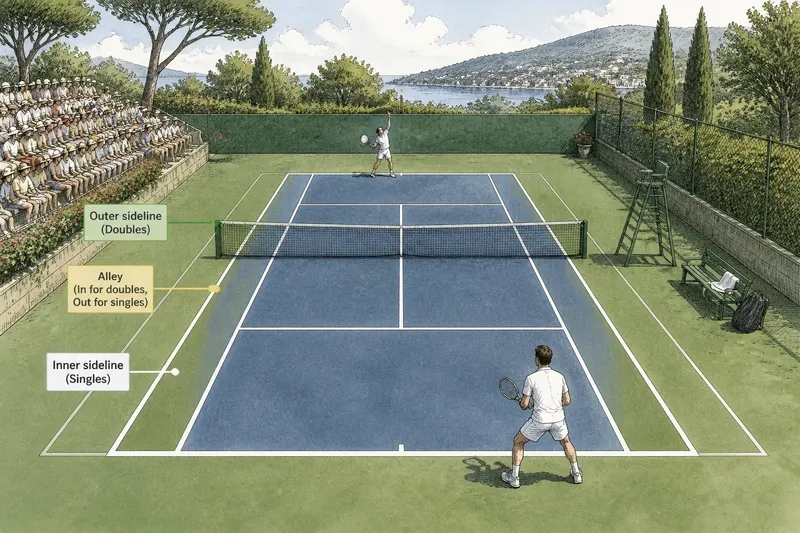
On a tennis court, the extra strips between the singles and doubles sidelines are not spare space: they are the doubles alleys. Tennis court lines outside the singles sidelines mark the court’s wider boundary for doubles, while singles uses the narrower inner sidelines. Which line matters depends on the format and the shot you are judging.
Which sideline applies to your match?
Look for the two parallel sidelines running lengthwise along the court. The inner pair defines the playing width for singles. The outer pair defines it for doubles. The area between each inner and outer line is an alley, and it counts as in during doubles but out during singles.
This arrangement lets one court serve both formats without changing the net or redrawing the whole surface. The court’s length stays the same; the boundary shifts outward when four players use the width. The lines are therefore a record of two playable layouts, not extra markings that apply all at once.
- Singles match: use the inner sidelines. A ball landing in an alley is out.
- Doubles match: use the outer sidelines. A ball landing in an alley is in.
- Casual rally: agree on the format before play. If you are practicing singles, treat the alley as out even if a ball lands there.
Say you and a friend are rallying crosscourt and a ball lands just beyond the inner sideline, inside the alley. If you agreed to play singles, call it out; if you are playing doubles, the same landing is in. The visible landing point has not changed, but the active boundary has.
How can you read the boundaries at a glance?
Start at the net and trace each long sideline toward the baseline. The inner lines form the narrower singles corridor. The outer lines form the doubles corridor. At the baseline, the relevant sideline meets the baseline at a corner; for singles, that corner is at the inner line, and for doubles it is at the outer line.
It helps to separate the court’s width lines from its service markings. The center service line runs from the net toward the service line, dividing each service box into left and right halves. The service line crosses the court between the net and baseline. These markings govern where a serve must land, but they do not replace the singles or doubles sidelines.
For a serve, the alley is not part of the service box in either format. A serve must land in the diagonally opposite service box, bounded by the center service line, service line, and the relevant sideline on that side. In doubles, the alley extends the rally court, not the service target. This distinction prevents a common visual mix-up: a wider doubles court does not mean a wider service box.
What fits your situation?
Are you watching a singles match?
Follow the inner sidelines, even if the outer lines are brighter or easier to see from your seat. If the ball lands between the two lines, it is outside the singles court. That narrow strip is part of the playing surface, but not part of the active singles boundary.
Are you watching doubles?
Use the outer sidelines to judge whether a rally shot is in. The alleys are included, so a ball can land outside the singles corridor and still be good. For serves, however, keep your attention on the service box rather than the full width of the doubles court.
Are you learning the markings before playing?
Stand behind a baseline and identify the inner and outer sidelines before warming up. Decide whether the session is singles or doubles, then mentally ignore the inactive pair of lines. This simple choice reduces confusion when a close shot lands near an alley.
Are several people sharing one court?
Agree on the format and boundaries before a rally begins. If some players are practicing singles while others wait, name the inner lines as the active sidelines for that game. Clear calls matter more than trying to reinterpret a landing after the point.
Why is the court wider for doubles?
Doubles asks two players on each side to cover the court together. The alleys add lateral room for placement and movement, giving partners more width to defend and attack. Singles, with one player responsible for the whole side, uses the narrower corridor so the playable area matches the format.
The added width changes tactics as well as boundary calls. In doubles, a shot directed toward the alley can pull a player away from the middle and open space for a partner. In singles, the same target is out, so players shape angles within the narrower lines. The markings quietly tell you what kinds of risk the format permits.
The alleys also make the court legible to spectators. From the stands, both formats share one surface, and the parallel lines show the alternate width without a divider or movable boundary. A viewer who knows which pair is active can follow the geometry of a point even from the far end.
Which details are not worth overthinking?
There is no need to memorize every line name before watching a match. For the width question, the useful distinction is simply inner sideline for singles and outer sideline for doubles. Nor is it helpful to treat the alley as a separate mini-court; it is included in the doubles playing area, not a lane with its own rules.
Line color can help, but it is not a dependable shortcut across every venue. Courts may use different surface colors and line contrasts, and glare or wear can make one set harder to see. Read the lines by their position: the singles pair sits inside the doubles pair.
If a court’s markings are unusual or hard to distinguish, ask the organizer which format and boundaries are in use before play. The court’s visible pattern is easiest to read once you know the match context. Remember the basic cue: the inner lines narrow the game for singles; the outer lines bring the alleys into play for doubles.