The Myth That Tennis Traditions Never Change
Tennis traditions change as clubs and crowds reinterpret them. Learn how to preserve a custom’s meaning while adapting its form to fit the people who share it.
Why does a tennis custom sometimes feel welcoming in one setting and stiff in another? The trouble is often not the tradition itself, but the assumption that its familiar form must never change. Tennis traditions can keep their meaning while adapting to the people, places and occasions that sustain them.
A tradition is a repeated practice that a group treats as meaningful: a greeting at the net, a particular way of marking a match, or a shared observance around a court. Its meaning may be respect, hospitality, fairness or belonging. Those values are not identical to the practice’s outward details. When a custom becomes difficult to join, a careful adjustment can carry its purpose forward more faithfully than rigid repetition.
Why does a familiar custom suddenly feel like a problem?
A custom can become a source of friction when its original setting changes. A club may have new members, a public event may attract visitors unfamiliar with local habits, or a court may be used by players with different needs. The practice still matters to some people, but its unspoken rules may leave others uncertain about what to do.
The first step is to identify the actual difficulty rather than arguing over whether the custom is “old-fashioned.” Is the issue that newcomers do not know the expected gesture? Does the timing interrupt play? Is a dress expectation being treated as a measure of respect when the real concern is orderly, comfortable participation? A specific problem invites a specific response; a broad complaint tends to turn into a contest over identity.
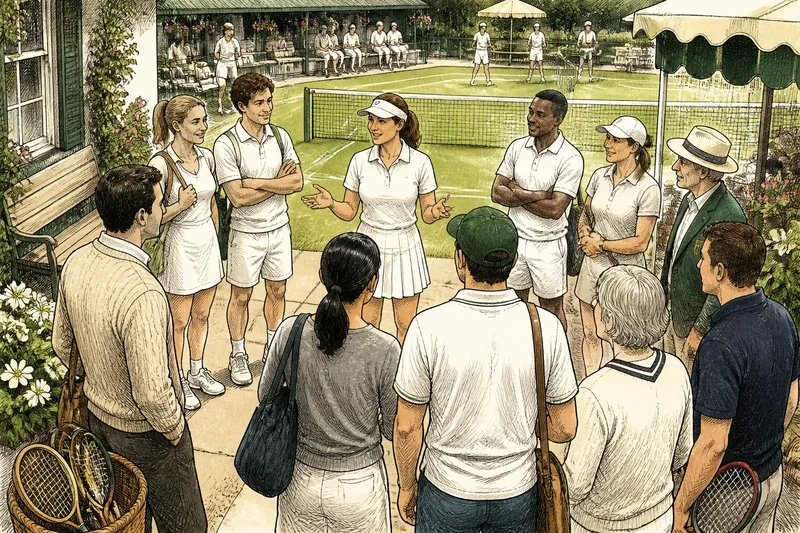
Say a neighborhood court has a customary pause before a social doubles match, but visiting players do not know whether they should join the circle or wait courtside. The organizers could explain the pause briefly and invite everyone to take part, without insisting on a particular speech or arrangement. The observable result to look for is simple: visitors know what is happening, and regulars can still mark the beginning together.
What should people try when a tradition excludes newcomers?
Unfamiliarity is not always exclusion, but silence can make the difference hard to see. A custom that seems obvious to long-time members may have no visible entry point for someone arriving alone. Explain its purpose, show the expected action, and make room for more than one comfortable way to participate.
For instance, a group might value the customary handshake after a match because it acknowledges the opponent. If a player cannot or does not wish to shake hands, a spoken thanks or a nod can convey the same recognition. The goal is not to erase the group’s habit; it is to avoid mistaking one gesture for the only possible expression of sportsmanship.
It also helps to separate participation from performance. A newcomer should not need to know a club’s private vocabulary, copy a particular style of dress beyond reasonable court requirements, or tell a personal story to show respect. A short explanation and a clear invitation are usually more useful than a test of whether someone has already learned the local code.
How can a custom change without losing its meaning?
Start by naming the value the practice serves. If players gather before a match to welcome one another, the value is welcome; the exact location, wording and duration may be adjustable. If spectators observe a quiet moment during play, the value may be attentiveness to the point; the precise ritual surrounding that quiet may vary by event.
Then distinguish essential features from inherited details. Ask which part people would miss if it disappeared and why. A court’s end-of-season gathering, for example, may matter because it lets players recognize one another’s effort. If the customary formal meal makes attendance difficult, a simpler gathering after play might preserve the recognition while opening the occasion to more members.
Make one modest change at a time and explain it plainly. A notice can say what remains, what is different and how participants can take part. Avoid presenting adaptation as a rejection of those who maintained the older form. Their care may be the reason the custom still has enough meaning to be renewed.
What goes wrong when people defend or revise a custom?
Several recurring problems can make a small adjustment feel like a larger dispute:
- Treating age as proof of value. A practice may be longstanding and still need explanation. Ask what it gives the group today, rather than relying on its age as the only reason to keep it.
- Changing the surface while ignoring the purpose. Replacing a greeting with a new slogan may leave participants just as unsure. First identify the value, then choose a form that communicates it clearly.
- Assuming every regular agrees. Traditions can matter differently to people who share a club. Ask for views across the group instead of treating the loudest defense or objection as unanimous.
- Making an informal rule sound compulsory. A custom can be an invitation rather than a requirement. Say which parts are expected and which are simply familiar habits.
- Changing everything at once. A bundle of new practices can obscure what each change is meant to solve. Adjust the point of friction first, then notice whether participation becomes clearer.
These are not reasons to discard customs whenever they feel inconvenient. They are prompts for diagnosis. Some practices need a clearer explanation; others need a different form; a few may no longer serve the purpose people associate with them.
When should a club keep a custom, adapt it or let it go?
Keep a custom when its purpose is understood, participants can join without undue pressure, and its form fits the occasion. Adapt it when the purpose remains valuable but the present version creates avoidable confusion or leaves people out. Let it go when the group cannot name a present-day value it serves, or when maintaining it requires people to accept a burden unrelated to tennis or hospitality.
That decision should come from conversation with the people who take part, not from an abstract rule that every old practice deserves preservation or every new preference deserves adoption. A club committee might ask players what they understand a custom to mean, who finds it easy to join, and what alternative could express the same value. The answers can reveal whether the real need is explanation, flexibility or retirement.
What is not worth the effort is policing tiny variations that do not alter the custom’s purpose. Insisting that every greeting use identical words, for example, can turn a sign of welcome into a test of obedience. Focus attention on whether people understand the practice and can participate in a way that preserves its spirit.
Which questions help settle a disagreement?
How can a club tell whether a custom still matters?
Ask participants what the practice means to them and what they would lose if it vanished. If answers point to a shared value, that value can guide decisions about the custom’s form.
Does adapting a tradition disrespect long-time members?
Not necessarily. A change that acknowledges the custom’s history and preserves its purpose can recognize the work of those who carried it forward while making room for new participants.
What if members disagree about the right version?
Separate the shared purpose from competing preferences about how to express it. Where practical, offer a choice or invite the group to try a limited adjustment and discuss whether it serves the intended purpose.
When is it better to stop a custom?
Consider ending it when participants cannot identify a worthwhile purpose, or when its burden falls unfairly on people expected to take part. Explain the decision and preserve any useful meaning through another practice if the group wants to do so.
How can a changed tradition become familiar?
A revised custom needs clear language and repeated, low-pressure opportunities to take part. Introduce it before the occasion rather than surprising people in the middle of a match or gathering. If the change affects a club event, a brief note on the noticeboard or in the invitation can tell members what to expect and why the form has changed.
Afterward, ask whether the adjustment did what it was meant to do. Did visitors understand how to join? Did regulars still recognize the value they cared about? If the answer is mixed, refine the details without turning the first attempt into a verdict on the tradition as a whole.
The myth that tennis traditions never change makes every adjustment sound like a loss. In practice, customs endure because people keep deciding how to enact them. When a group can explain a tradition’s purpose, offer a clear way in and reconsider details that no longer serve that purpose, tennis tradition remains recognizable without being frozen.